
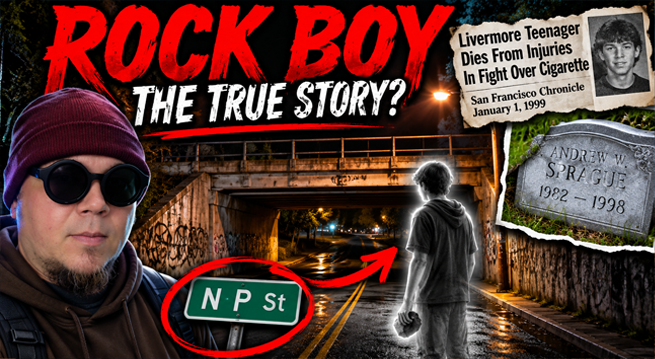
The REAL story of ROCKBOY?
Did I Find the Real Story Behind Livermore’s Rock Boy Legend?
After releasing my Rock Boy video, I uncovered a tragic death from 1998 that may explain how one of Livermore’s strangest urban legends began.
Recently, I made a video about Rock Boy, a local ghost story that’s been circulating around Livermore, California, for years.
According to the legend, a young boy used to hang around an overpass throwing rocks at passing cars. Eventually, an angry motorist confronted and murdered him.
Now, people claim that if you visit the overpass late at night, shut off your engine, and sit quietly, you might hear rocks being thrown from somewhere in the darkness. Some even claim to have seen the apparition of a young boy near the railroad tracks.
In my original Rock Boy video, I focused on the North Mines Road overpass, a location identified by some Livermore residents as the site of the haunting.
But after releasing the video, I continued researching the story and came across something that changed my perspective.
You can watch my original Rockboy video here:
I now believe there’s a real possibility that the Rock Boy legend was inspired by a teenager named Andrew W. Sprague, who died following a confrontation near railroad tracks in Livermore in December 1998.
And the similarities are difficult to ignore.
The Real-Life Tragedy of Andrew W. Sprague
On January 1, 1999, the San Francisco Chronicle published an article titled Livermore Teenager Dies From Injuries In Fight Over Cigarette, written by Tanya Schevitz.
The article documented the death of 16-year-old Andrew W. Sprague, a junior at Livermore High School.
On the night of December 29, 1998, Andrew and a friend were taking a shortcut across Union Pacific railroad tracks near Ventura Avenue in Livermore.
At approximately 10 p.m., they encountered a group of young people, and an argument developed over cigarettes.
As Andrew and his friend attempted to walk away toward the 1300 block of Ventura Avenue, members of the other group allegedly began throwing rocks at them. Andrew reportedly threw a rock back.
The confrontation escalated when one of the suspects allegedly punched Andrew, causing him to fall backward onto the asphalt and suffer a severe head injury.
Andrew never regained consciousness and died on December 31, 1998, at Eden Medical Center in Castro Valley.
Two suspects were arrested in connection with his death.
This was a real tragedy involving a real teenager, and the details immediately reminded me of Rock Boy.
A Forgotten Version of the Legend
In August 2016, someone left a comment on the Weird California website claiming that the commonly repeated Rock Boy story wasn’t the original version.
According to this commenter, Rock Boy had gotten into an argument with another kid over a cigarette. Rocks were thrown, and the boy fell backward, striking his head near the railroad tracks.
The commenter also claimed that a former boss had attended school with the boy involved.
That account sounds remarkably similar to Andrew’s documented death.
Both involve a teenager, an argument over cigarettes, rocks being thrown, railroad tracks, and a fatal head injury.
There is one important difference. The newspaper reports that Andrew was punched and struck his head on asphalt, while the folklore account describes a different sequence of events.
But could the 2016 commenter have been repeating a story that had changed slightly over the years?
I think it’s possible.
And then I discovered another detail that makes this connection even more interesting.
The Cemetery Connection
At the end of that same 2016 comment, the person claimed to know Rock Boy’s real identity but didn’t want to reveal his name publicly.
Instead, they offered a clue.
The boy was supposedly buried in a cemetery on East Avenue in Livermore.
I decided to look into it.
While searching the Livermore-Amador Genealogical Society’s burial records, I found Andrew W. Sprague listed at Memory Gardens Cemetery, located at 3873 East Avenue in Livermore.
His burial record lists:
- Born: April 12, 1982
- Died: December 31, 1998
- Age: 16
- Cemetery: Memory Gardens, Livermore
- Gravesite: ETL-28-E-5
The death date matches the contemporary newspaper report.
This is particularly interesting because the cemetery detail wasn’t part of the commonly repeated Rock Boy legend. It came from someone in 2016 who claimed to know the real story.
And now we have a documented teenager whose death matches several details of that account, including his burial at a cemetery on East Avenue.
It’s not proof that Andrew was Rock Boy, but it’s a pretty compelling coincidence.
Was the Original Overpass Actually on North P Street?
Finding Andrew’s story also made me reconsider the location of the haunting.
For years, people have debated which Livermore overpass is associated with Rock Boy. North Mines Road is one popular location, and it’s where I focused my original video.
But the 1999 newspaper article places Andrew’s fatal confrontation near the railroad tracks along Ventura Avenue.
Looking at the area, there’s another railroad crossing nearby: the North P Street underpass.
Unlike North Mines Road, where the road crosses above the railroad tracks, North P Street passes directly beneath them.
This is significant because the original Rock Boy legend specifically describes people parking their cars underneath an overpass.
And there’s another clue pointing toward North P Street.
In April 2018, a commenter on Weird California mentioned a possible Rock Boy location near a bowling alley.
Right beside the North P Street underpass was Granada Bowl, a longtime Livermore bowling alley on Railroad Avenue.
A 2009 City of Livermore study even documents the underpass, identifying Granada Bowl on one side and a former Kragen Auto Parts store on the other.
So now we have a location that fits several important details: the railroad corridor near Ventura Avenue, a roadway beneath the tracks, and a bowling alley mentioned in discussions of the legend.
The bowling alley commenter was asking about possible locations rather than confirming one, and the newspaper doesn’t establish that Andrew’s confrontation happened at the underpass.
Still, North P Street is beginning to look like a plausible alternative to North Mines Road.
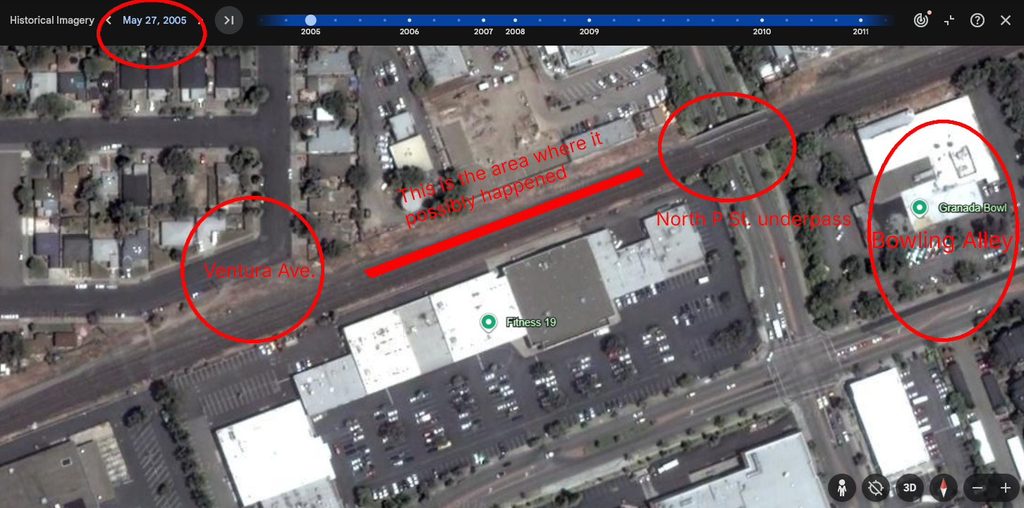
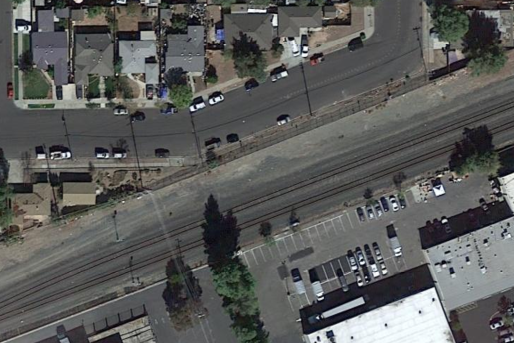
I want to point out that this image is from 2005 and it appears there wasn’t a fence in between Ventura Ave and the railroad tracks. This would make it easier for people to use the railroad tracks as a shortcut.
In this newer image you can clearly see what looks like a fence.
How a Real Tragedy Could Become an Urban Legend
This is where the story gets interesting from a folklore perspective.
Imagine a teenager dying after an argument near railroad tracks in 1998. Rocks were involved, and the incident became known throughout the community.
Over the following years, the story gets passed around among local teenagers.
Details begin to change.
The argument over cigarettes becomes a story about a boy throwing rocks at cars. The confrontation becomes an angry motorist seeking revenge. The railroad crossing becomes a haunted overpass.
Eventually, people begin claiming that if you visit the location at night, you can still hear rocks being thrown by the boy’s ghost.
And just like that, a real tragedy could evolve into an urban legend.
It’s also possible that as the story spread, the original location became confused with other railroad crossings around Livermore.
That might explain why different people identify different overpasses as Rock Boy’s haunting grounds.
Of course, this is only a theory. There’s no documented chain of accounts proving that the legend developed this way.
But it offers a possible explanation for how the historical incident and the ghost story became so similar.
So, Was Andrew Sprague the Real Rock Boy?
I can’t say for certain.
No historical source I’ve found explicitly identifies Andrew as Rock Boy, and the original location of the haunting remains unconfirmed.
But the similarities are striking.
A 16-year-old boy died near Livermore railroad tracks in 1998 following an argument involving cigarettes and rocks.
Years later, someone describing the Rock Boy legend recalled nearly those same circumstances and even mentioned a cemetery on East Avenue, where Andrew is documented as being buried.
Add the geographical clues pointing toward the North P Street underpass and the nearby Granada Bowl, and I think there’s a legitimate reason to reconsider the origins of this legend.
I originally set out to make a video about a local ghost story.
Instead, I may have uncovered a real-life tragedy that helped inspire it.
Perhaps somewhere beneath the rumors, exaggerations, and paranormal encounters is the memory of a real teenager whose life ended far too soon.
I’m not claiming to have solved the mystery, but I believe Andrew W. Sprague’s story deserves to be part of the conversation.
And I now think the North P Street railroad underpass deserves a much closer look.
Chill Seekers Paranormal Research